
TAMP Season 8 Episode 3 Lester Harris at Royal Enfield with Mark Wells
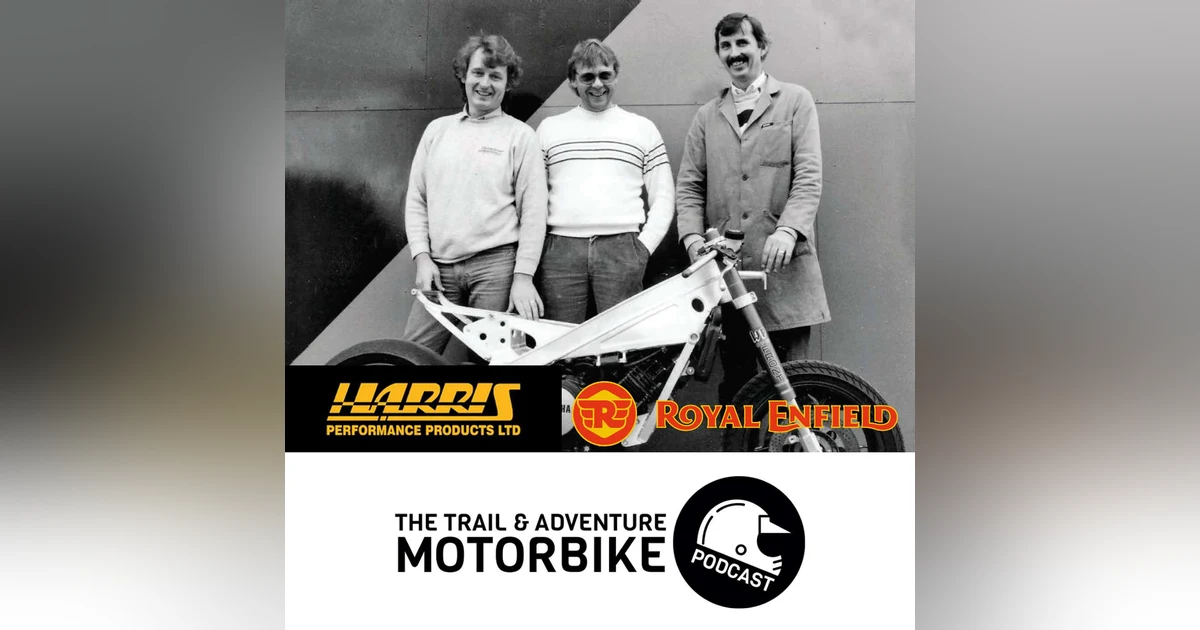

Send us a text Harris Performance was a renowned British motorcycle engineering company established by brothers Lester and Stephen Harris, along with Steve Bayford in the 1970s. Famous for designing and manufacturing high-performance racing frames and components, they were instrumental in the development of grand prix and endurance racing motorcycles. Origins: Founded in Hertford, UK, by brothers Lester and Stephen Harris, the company gained a reputation for creating superior chassis for larg...

 Apple Podcasts

 Spotify

 Castro

 RSS Feed
Harris Performance was a renowned British motorcycle engineering company established by brothers Lester and Stephen Harris, along with Steve Bayford in the 1970s. Famous for designing and manufacturing high-performance racing frames and components, they were instrumental in the development of grand prix and endurance racing motorcycles.
- Origins: Founded in Hertford, UK, by brothers Lester and Stephen Harris, the company gained a reputation for creating superior chassis for large-capacity racing engines.
- Racing Impact: Harris Performance designed and built frames for various racing categories, including Grand Prix 500cc and endurance, working with major manufacturers like Yamaha and Suzuki.
- Legacy: They became renowned for making bikes faster and better handling through custom-engineered, lightweight steel and aluminum frames.
- Acquisition: Royal Enfield acquired the company in 2015 to bolster their chassis design and development capabilities, integrating their operations into the Royal Enfield UK Technology Centre
42:26 - No Title
0:33 Hello and welcome to the Trail and Adventure Motorbike Podcast. With me, Clive Barber, and my good mate, Mark Wells. For the days when you can't ride your bike, there's always the Trail and Adventure Motorbike Podcast. Well, I'm delighted to say that today, a bit of an outing for me. 180-mile trip down the motorway. We're in uh Leicestershire at Bruntingthort, what's it called? Bruntingthort Proving Ground. Proving Ground, which is the home of the Royal Enfield Technology Centre. And I am very excited because not only I'm am I here with old friend of the podcast Mark Wells, but I'm also with the legendary. He's smiling now. For those of you that know anything about motor racing in the 70s and the 80s and the 90s, we'll will recognise the name Harris Performance, and I'm delighted to be joined by Lester Harris.
1:24 Thank you for inviting me. I've been very excited about this for a long time now. The snow got in our way last week, but we've got back to it now. Lester, for those that don't know much about the racing of the 70s and 80s and 90s, tell us a little bit about yourself. Lester Harris, I'm now 74. My brother and I started our company back in the very early 70s. And really, I've been involved in designing and building and racing motorcycles all my life, up until the point about um eight years ago when Royal Enfield purchased our company. I am now retired, but I'm still involved in bikes one way or another.
2:05 I met you at Alton Park and you were supporting your son Cameron. Yeah, well, both my boys, I suppose inevitably really, they both got into racing very early on. Motocross, enduro riding, and then my youngest son decided that he wanted to go road racing. And he was fairly old then, he was 27, I think, when he started road racing. But anyway, we got to a point where he wanted to do we went to BSB, and we've had a couple of years of BSB. That's sort of come to an end now because of normal house, you know, partner, job, business, all the things that stop you enjoying yourself racing. I had a load of good fun with my boys racing.
2:46 Tell me, how did you feel when he said he wanted to go road racing? Were you were you delighted or were you a little bit trepidatious about your little boy going racing? A lot of trepidation, to be honest with you, because when the boys were little and our company was more high profile, they were really interested in bikes. I'm talking about when they were like eight or nine years old. But I didn't really want them to go road racing because I felt that there was going to be a huge pressure upon them being Harris Performance products, and I didn't want that really. I wanted them to be able to go racing and enjoy themselves. I took them schoolboy motocrossing and they really liked it, and I thought, great, we'll stay motocrossing.
3:28 We did that for years, probably 15 years. Eastern Centre Motocross did some national championships, and then Cam said to me, he said, Do you know what, Dad? He said, I wouldn't mind doing just one year of road racing before I pack up. I thought, oh, one year, that'll be alright. So uh we built this mini twin, but unfortunately, he won his first race and won his championship in the first year. So I thought, ah, blow. We then had another eight years of um road racing. To be honest with you, like all dads, racing with your sons is great and terrifying at the same time. But I love it, they love it, so you know.
4:10 Mark Wells, that was a very happy Christmas in your house for your boys as well, wasn't it? It was, yeah, yeah. They've ridden a bit over the years. They've had when they were little, they've had a uh a couple of ossits and electric bikes. We go up to um Cumbria Motor Park up in my way. Yeah, yeah, north North Lakes, where Jenny's folks are from, and they've ridden the KTM EV bikes. Um they're brilliant. Place if if anybody's looking for somewhere to take their kids, it's a fantastic facility. It's really reasonably priced. You turn up, they've got all the kit, and away you go. But yeah, this this Christmas we bought them a secondhand little KX65 and a KX85. Just trying to find some boots and kit that actually fits. I keep getting all the sizes wrong that I've ordered, but uh and then bought an ambulance, an old secondhand ambulance. That might come in handy.
4:52 The idea is it's it's a day van, it's it's for for moving the kids around in and moving the bikes around in. But yeah, it should be interesting. We'll see. I'll see what that journey's like. I mean, I don't think either of mine show any real aptitude for it. They're not I'm not quick, and I don't think they're gonna be quick either. Well, they're very young still, aren't they, as well, for it? Albi's nine and Joe's twelve, so no, in some ways they're late starters. You know, there's there's lots of kids that have been doing it five years. If you go to schoolboy motocross, you look at some of these eight or nine-year-olds, they are fast. I mean, some of them are incredibly talented. I'm always amazed. You'll have great fun. Our year's schoolboy motocrossing was really good fun.
5:32 That's that's 100% what it's about. Um I'm not really expecting them to do anything. I don't even think I'll take them racing to start with. We're just gonna go do practice days and just let them get used to it. They did a day down at Milan Hall on 65s with clutches, and every time Albie stopped, I was riding as well, but every time I looked over and Albi stopped, I just saw him fall off. He didn't he didn't actually master the clutch at all. He just would would stall it and then fall off and then get himself up and wander off as if that's how you did it. Sometimes it's very surprising. You meet people who are quiet and not aggressive, but when they put that crash helmet on, they change. So you can never really tell. Some people have just got that race attitude.
6:12 Both my kids are like that. Kids, they're blokes now, you know, they're not kids anymore. And they are highly competitive and they like racing. We haven't actually introduced you yet. Tell us, tell us who you are and where we are, more importantly. I'm Mark Wells. I'm chief of design at Royal Enfield, COD, cash on delivery, COD father, whatever you like. And I look after Royal Enfield's industrial design, product strategy, concept development, right from the very kind of genesis of an idea for a product all the way through to production, understanding the voice of the customer, putting that into the bike. Where we are today is Royal Enfield's tech centre. This is a purpose-built facility here in the UK, fully owned by Royal Enfield India, and we're about 170 engineers, designers, and then supporting people.
7:02 And we can design and develop bikes completely here, and we have a full testing facility here, dinos and everything you can possibly think of. We just had a walk around and you know that that we can effectively design from a clean sheet of paper to a fully functioning production road bike in this facility. Like Christmas morning for me this morning, waking up, coming down here, knowing what I was going to see. And it hasn't failed to impress, that's for sure. You've got all the toys, haven't you? We have, and it's a wonderful place to work. I'm very blessed to work here. It's just a huge collection of enthusiasts. It's a bunch of people that are like-minded and that love bikes and everything around it. And every day you come to work, you're interacting with people. For example, I've got on my team, I've got a guy that runs a semi-pro level motocross.
7:43 I've got an Isle of Man TT racer, I've got custom builders, I've got designers from all over the world. We're really international teams. I think Anton met you at the door of those French and Australian and German and obviously Brits and Indians and just anywhere you can think of. And I love that. I think it's an amazing place to be. Very, very impressive, and it's nice to see you working on the TAM podcast special that we talked about when we last had the trips. Wing wing nodded nudgits on its way. Let's get back to you, Lester, which is why we're here. Tell us about what you were doing before you started Harris' performance. Presumably you were on the tools, I guess. Well, I was, but you know, Steve and I, my brother Steve and I started our business when we were very young, really.
8:24 We didn't come from a motorcycle background. My family had nothing to do with motorcycles, but we lived in the country. We had access because our pals were sons of the local farmers, so we had loads of access to the fields, and so we had loads of terrible old motorcycles that we used to charge around the fields on. Then we both went and did apprenticeships. Steve did a welding apprenticeship, I was a fit attorner, and when we finished our respective times, he went to work for a local company called Racing Frames, who built Lotus space frame F1 cars.
9:09 Lotus were at that time based in Chesham, which was near where we were. So there was quite a lot of industry supporting Lotus. Racing Frames used to build these tubular space frame chassis. So Steve went and worked there, and I went and worked for a company called Zipcarts. Well, not zipcarts, but the people who built the zip carts, cart chassis. I know them well. I think I used to own one at one point. Zips were probably the most successful cart manufacturer of that era. We were quite friendly with Martin Hines, who was the guy who actually owned zip carts. Because of that, working in an environment that was building race machines, we got interested in going racing.
9:53 We clearly weren't going car racing because, you know, we were working class boys, but we like motorcycles. And so my brother started racing first, built a 650 BSA. When you say built, well, actually, he didn't actually build it. There was a local dealer called Dick Rainbow Motorcycles, and Dick mentored a chap called Tony Smith who went on to become a factory BSA rider, top, top rider. So Steve went down there one day and said to Dick, Would you build me, prepare me an A65 BSA for racing? So it's basically a production racer. So Dick said, Yeah, I'll do that.
10:35 He built this bike for Steve. Steve is two years older than me. He did a year's racing on it. Did quite well actually, didn't crash. It was pretty good, really. So at the end of the year, I wanted to go racing, you know, Big Brother's racing, and I wanted to go racing. So he said to me, he said, Well, let's go up to Sneterton and have a ride on my bike, see what you think. We did that, and Dick was there, actually, Dick Rainbow, and he said, I'll tell you what I'll do, Leicester, I'll show you round the circuit. So I thought, right, so we we we set off and we do one lap, and on the second lap, being a cocky little perishier like I was, I thought he's going too slow, I'm gonna overtake him.
11:18 Just on the entry to Coram Curve at Sneterton. Well, I just ran out of road and cartwheeled Steve's bike down the track. I mean, I mean, Coram, even at my speed then, it was a fast corner. Julie, I um had to buy it off him. So that was it, really. I then did a season on a uh an A65 and Steve he went to work for Ruggs for a motorcycle dealer. They supplied him a bike, Triumph um Thruxton, Bonneville. So we did a bit of racing after my first season. I bought a G50 matchless. By then we were competent engineers and we were but working in an environment where we were building tubular chassis, bronze welding them up, and we thought, foolishly, that we should start a little business making parts for motorcycles to pay for our racing.
12:21 But of course, what happened is we got successful quite quickly and it finished our racing. Within six months, we had both stopped riding because customers' work had to come first. I did find that a little bit difficult really, because the very reason we went into it was because we wanted to race ourselves. Because I'd been doing all this work for Martin Hines at zip carts, carting at that time had a 250 class, but because they were concerned about keeping the cost down, they banned Yamaha motorcycle engines, they said they're too expensive. Martin developed a 250 Suzuki for racing and carting, and so he said to us, Well, if you want to build a bike, I'll give you one of our race engines.
13:09 So we thought that's that's a good idea. At this stage, we had never designed a bike. We built lots of bits, but we'd never actually designed a bike. So we built a chassis for a 250 Suzuki, which was quite a trick little thing actually. But the problem was what we hadn't realised the engine characteristic of a cart engine is not suitable for a motorcycle. It was almost unrideable because it had a standard gearbox, the gap between the gears was too big. Because in karting, they're spinning the wheels all the time, so they're keeping it revving. We can't race a motorcycle like that. So um that was not a success, but we'd built a bike, complete motorcycle.
13:54 Where did you do that, Lester? Are you still are you still working at this point, or have you now got your own premises or no? We both stopped work and we rented a stable behind the village butcher shop. It was it was a rundown shed. We had no machine tools, everything was made by hand, absolutely everything. I think at that time we didn't even have a lathe. Actually, now I look back on it, I don't know how we made it. But anyway, we did. And um that sort of attracted other people because the thing was, back then, there was a lot of scope for small companies back then.
14:35 Because you had a situation where the British motorcycle industry was finished, the Japanese had come in with all these ultra fast motorcycles, but they actually they had great, great engines, but the cycle parts, the suspension, the chassis weren't that good really. But the writing was on the wall. If you wanted to go racing, you needed a Japanese engine. I mean, I'll give you an example. When I raced my G50 match list, now G fifty's and Manx Norton's were the thing that that was what you raced at the British Championship, right? They had a speed trap at Snetterton on the old Norwich Strait, which was a three-quarter mile long straight. My G50 did I think it was just about 120 miles an hour.
15:20 Rod Scivia was there on his 350 Yamaha in the same race, his bike did 146. So you can see, I mean, there was almost overnight the British bikes were finished. So everything was turned on its head, really. But because they were great engines but had such a lot of scope to improve them, it spawned loads of little companies, little engineers who had a workshop who were a bit innovative. People were prepared to buy this stuff because then production racing sort of was a little niche class, really.
16:02 Most racing classes were proper race bikes. So everyone who went racing knew they had to build a bike, you know, they knew they had to do a lot of work on it. If you could offer something that improved their bike, there was a market for it, as long as it wasn't too expensive. But the thing that made the big difference was changing the rear suspension because Yamaha were starting to dominate racing. I mean 250 and 350 Yamaha's, they were the thing for everyone to have but they were twin shock, didn't steer particularly well. Yamaha's European trials team came up with the idea of converting one of their factory trials bike to monoshock.
16:47 Well, we and other people like ourselves, I'm not pretending we were the only people who did it, looked at it and thought that is a good idea for road racing. We started converting 250 and 350 Yamaha's from twin shock to monoshock. Why is that a better design? Two things. Firstly, it made the swing arm stiffer. On most of these twin shock swing arms were weak. Secondly, the shock absorbers themselves were not matched on either side and were non-adjustable. Well, if you made a triangulated swing arm to take a monoshock unit and then used a single adjustable shock absorber, you've stiffened the thing up and you've got better suspension characteristics.
17:38 Now we used a decarbon shock absorber, which was a car shock actually. They were made in Paris. It was a gas shock, adjustable shock. Well, you couldn't buy anything like that in the UK. Even if I had spring preload adjustment, it was only in three positions. It didn't have a threaded body on the shock, so you could wind it up exactly to get the preload you wanted. So there were quite a lot of advantages, really. We did hundreds of conversions. And not just ourselves, Spondum were another company who sort of started about the same time as us, and there were other people, Tony Foal and and all over Europe actually, there were little companies doing this sort of thing.
18:23 I think there was hardly any of those twin-shot Yamaha's anywhere that weren't modified. Why didn't Yamaha do that? Why is it two guys in the back of a butcher's? I think one of the reasons is, and I think this is something that you're in a way seeing a little bit with the Chinese at the moment is the Japanese came into the market, they were fixated on engine power. They had no real history of road racing or competition, a little bit like Royal Enfield, to be honest with you. Don't really race in India, do they? And so consequently, I think their attitude was we'll just make a much faster bike, which they did, and use the sort of technology that was common for race bikes and road bikes of the day.
19:14 But the thing is when you were racing, let us say a Manx Norton, the suspension was crude, but the bike only made fifty horsepower. Basically all you needed is a stiff chassis so that the whole thing wasn't twisting the wheels out of line. And the way you rode them was by just maintaining loads of corner speed, breaking as little as possible and just swooping and well when you suddenly double the horsepower, that horsepower affects the handling of the bike. A, you can't ride it in the same way, and if you haven't got decent suspension, you don't get grip.
19:55 The Japanese learnt very quickly. But by then there was quite a European industry of small companies like ourselves building complete chassis, different uh suspension units, different forks, different triple clamps, all those things. Now there's no doubt about it that over the years the Japanese developed very quickly and produced really good stuff. There's absolutely no doubt about it. It but in that period in the 70s and 80s, there was a lot of scope for improving these bikes.
20:42 For us, after doing all those monoshot conversions, Honda had already brought out the CB750, which was a bloody nice bike. But then Kawasaki brought the Z1 out, which was a bit of a fire-breathing monster, but they didn't steer at all. They had spindly little forks. They were heavy with a great big wide engine. The brakes were shocking because they were disc brakes, but they were stainless steel. So you know, in the wet, they didn't work. So there was loads of scope to improve them. Now again, over the years, obviously Kawasaki learnt quick and improved them, but in the late 70s we decided to go endurance racing.
21:28 We built a monoshock endurance bike with a Z1 engine in it, different forks, different brakes, different everything, really. There was all sorts of people doing stuff like that. Because even then there wasn't a really big production racing class. Still, if you wanted to go racing, you needed to build a proper race bike. At this point, is this still just you and Steve? We were extremely lucky because Steve and I started the business and we were practical engineers. What we weren't was businessmen. Luckily, one of Steve's school friends who we'd kept in contact with was a lot more business minded than us. This is Steve Bayford, and he joined us very early on.
22:11 That is one of the things that I really I'm really grateful for because if it had been down to me and my brother, we would have probably gone broke actually because we just wanted to build race bikes and go racing. Our third partner would rein us in and say, whoa, hold on a minute, you know, that's going to be a loser, you know, and try and just keep us on the straight and narrow, really. So we had a good combination of business acumen and a bit of technical expertise, and and that that worked. Obviously, I know Steve Bayford and I knew Steve H. as well. But just talk a little bit about their personalities because I think all three of you had such different but complementary personalities.
22:53 We were so lucky, actually, so lucky. First thing was having three directors or partners was really good because what happened is we went with a consensus, two against one, and then we'd go with whatever the consensus. And we saw so many partnerships fail because you had two partners, they didn't agree on something, it all ended up acrimonious. But what we had was Steve Bayford, very gregarious sort of chap, but also very business oriented. My brother was very innovative, very what's the word?
23:35 Very friendly chap. He knew everyone, absolutely everyone. And he was the sort of person who he would come up with loads of good ideas. He came up with some crazy ideas, it has to be said. But by and large, he would come up with a lot of ideas. I was more always more of the backroom boy, because Steve would have the idea, but I'd have to do it, make it happen. But that was good because we needed each of those things. So those three different personalities, and and we were very different personalities. We sort of rubbed along pretty well, really, and got on pretty well, never really had any arguments, and um basically had a good time.
24:23 How did you go from making these, presumably with all the monoshock conversions, you were hands-on and doing the welding yourself, or Steve was doing the welding? What was the first sign that the business was gonna take off and you need to take more people on to do more of the work? Well, it was undoubtedly when we built the Magnum 2, because we'd been doing all this short circuit racing, then we decided to go endurance racing and we built this bike. We built a few bikes actually, but we ran a bike with um Mike Trimby, funnily enough. Mike Trimby ran Ertha. He was a good pal of ours, but he obviously then he was just a racer. Mike Trimby and Andy Goldsmith. We did the European 24 hour series and we built a few bikes for other people.
25:07 Well, of course, an endurance race bike has got lights on it, so we sort of said, Well, it's nearly a road bike.
26:40 Why don't we build a road bike? See, this is what I'm saying. Then there was the opportunity to just do that. You could afford a little tiny company like us working in a shed, really, could afford to do that. I don't think you can today. Because the standard that you'd have to achieve straight away is so high, I just don't think a little company would be able to do it. But then we thought we'd be a road bike. So we built the Magnum 1, which was essentially our endurance bike, and we styled me and Steve styled the seat tank and fairing. Well, it was different, but it weren't very nice.
27:23 We we thought maybe styling is not our forte. This was the time when Suzuki had just launched the katana, and they made a big deal of the fact that the katana was styled by a company called Target Design. And my brother, this is an example of my brother, he said to me and Steve, he said, Well, we need Target Design to style our bike. It transpired, it was only a two-man business. They had done the katana for Suzuki, which was let's face it, was a groundbreaking bike. Steve Baker and I said, Come on, they're not gonna style our bike.
28:06 My brother said, Well, I'm gonna phone them and I'm gonna see whether they will. Got on to um onto Target, and because they were only a little company, they wanted other work, so they said, Yeah, we'll we'll do it. So they styled our bike. We gave them a Magnum, a Magnum complete bike with no bodywork on it, and they styled it, and it it was a bit katana-ish, a little bit, but it was an immediate success. And we we built a lot of them, but that is the the product that changed us from being a little job in engineering shop, really, who would take on anything that came through the door, to suddenly we had a product, a complete product there was a quite good demand for.
28:58 We needed to up our production. That is the thing that changed us really when we took a big gulp and took a lease on a bigger building, employed more people, and generally tried to productionise it a bit. Let's be honest. I mean, we're not we were not talking about big companies here, but we were making probably uh our height of those Magnum's Magnum 2s, we were probably making three or four a week. So it wasn't bad. Well at that time you were probably one of the biggest bike manufacturers in the UK at that point. Then you're right, because Triumph had gone, you know, the British industry was finished.
29:38 Our main competitor really was Spondon. Spunden, good company, made a lot of really good stuff, but they never really went that route. They stuck to racing. They also never ran their own teams. I'm not saying that's good or bad, but they went that route. Well, we we were a little bit more um ambitious, if you like, as far as the road bike side of it is concerned, because we could see that much as our passion was going racing, racing is a very up and down, it's very difficult to run a business just based on racing. The parallels with Formula One and the original Garage Easters, and you mentioned the space frames like the birdcage Maserati.
30:23 We built two of those for a bloke. Wow. Replicas. He brought one down to us. I don't know, I don't know why he brought it to us. I must be honest. Anyway, we built two of them. I suppose he thought, well, you know, the sort of thing we do, tubular stuff. It takes racing to progress the technology because you really have to be right at the very edge of the technology to then improve it, presumably, because you ended up going, you were Moto GP 500 racing, you were world super bike racing and everything else in between. The development on the engine side spawned everything else. And the Japanese were making faster and faster and more powerful bikes. Everyone had to catch up, the tire manufacturers, the suspension manufacturers, frames, everything.
31:06 There was loads of scope because you almost couldn't keep up with this increase in power. There was a lot of scope to do stuff, and there was a lot of demand for it. We were in an extremely fortunate position. Just going back a bit, Lester, you were saying before that you did an apprenticeship. The stuff you guys produced was absolute art. Where did you learn that craft? I've got to be honest, some of the early stuff we made wasn't that good. You know, we were learning as we went on because I say when we started, we'd never designed a motorcycle, and no one had told us how to do it, but we were making things for other people using those sort of techniques.
31:48 So we thought, well, we know a bit about riding, about what you what the rider wants, and we know how to make stuff to a decent standard, so let's have a go. The work Steve was doing at Racing Frames and the work I was doing at Cameron Engineering for the for the cart chassis, it had to be good. They wouldn't accept second rate stuff. Everything was bronze welded. And why is that why would you bronze weld? The thing about bronze welding was it's it was really developed for the bicycles. When you had the very thin gauge tube, if you put a fusion weld, if you join two tubes together with a fusion weld, there's a high likelihood it will fracture on the edge of the weld because there's a lot of vibration and flex going into these frames.
32:40 So Reynolds, the tube manufacturer, developed a tube called 531 for bicycles, and it was a tube that didn't lose as much of its tensile strength if you welded it with a low temperature welding technique. Well, bronze welding is much lower temperature than arc welding or TIG welding because you're not actually melting the parent material, you're just melting the filler rod onto the parent material, and the shape of the weld itself is concave, so it means the transition in the corner where the weld is, where two tubes join together, is much gentler.
33:25 Because the thing that causes fractures is when you get a very sharp, abrupt change of cross section, that is where you'll get a fracture. Bronze welding, is it different to brazing then? Yes, in as much as with brazing, you just basically heat the material up and drop a bit of molten bronze onto it and it just spreads all over it. And it was really developed when, again, for bicycles, where they'd lugs, and you'd heat it up, put a bit of bronze on it, and it would just the bronze would just be sucked inside the joint. Bronze welding is where you use a filler rod and deposit little drops of filler onto the joint.
34:09 It's quite labour intensive, but if you're using light gauge tube, it's more reliable. Over the years, we could have gone more to TIG welding because, particularly on the road bikes, we weren't using ultra-thin tube because you're building something for the road, it's got to be reliable and all the rest of it. But bronze welding was very, very popular. It was synonymous with racing, it's what people wanted to see. That naked unpainted frame where you see the little bits of bronze at the joints, just looks the business, doesn't it? It does look the business. You've got one in reception, haven't you, which I was looking at that seems to be bronze welding.
34:49 That's the bike we built for Bonneville to do this speed record attempt. One of the most beautiful bikes here as well. That was only a few years ago, wouldn't it? We did that. And but we did get the record, it's not very fast. There's a record at Bonneville for every conceivable motorcycle you can think of. But that was really interesting, that project. I learned a lot about that actually. I mean, if I had to do build one of those again, I would build it quite differently, to be honest with you. But yeah, going back to welding, bronze welding was what people in the motorcycle industry, I'm talking about in the 60s and 70s, people wanted. And it was the right thing at the time. Obviously, for us, as we progressed, we started making and everyone started making aluminium chassis.
35:36 Obviously, you Tig weld aluminium, it's it you know, everything changes when you make it out of aluminium. But there again, and again, I'm not just saying that we were that clever, but most of the other chassis manufacturers realize this. When the Japanese first made a an aluminium chassis drove bike, the GSXRs, they basically replicated a tubular steel frame in aluminium. Well that was just wrong, you know. You need a big cross-sectional area, really. So that's the difference between steel frame is relatively strong, and to replicate that strength with aluminium, you need something much bigger.
36:17 Exactly right. So it's a completely different approach to how you build it. At the end of the day, you just need to build a structure that is strong enough and weak enough in some areas for what you want it to do. There's all sorts of ways you can make it. You can make it tubla, you can make it in carbon fiber, you can make it in aluminium, so long as it does the job. People get it wrong. We all we all get it wrong, you know. But I mean, I'll give you a good example of that. When we went Grand Prix racing with the YZR500 Yamaha's, Yamaha said to us, we'll supply you Grand Prix engines. We will give you as much or as little help as you want. This is because Yamaha wanted there to be private air bikes on the grid because in the 90s, early 90s, Grand Prix racing was struggling.
37:05 I mean, there was only about a dozen riders on the grid. You couldn't buy a Grand Prix bike. So they were only factory bikes. We got hold of one of Rainey's old chassis. Well, it was immensely strong, the chassis. When we cut it open inside, it was a large cross-sectional area chassis, but inside had loads of buttresses and webs and everything. Well, basically, it was too stiff. Simple as that. Because those bikes were really powerful and really aggressive the power. So you needed a bit of flex in the chassis. Not torsional flex, you need a bit of lateral flex.
37:48 Otherwise, when you get on the gas, you know, you're just gonna lose grip and crash. Of course, Yamaha quickly learnt that as well. This is what everyone was learning, you know, they build a an engine with 20 more horsepower. Well, that introduces a load more problems that they didn't have last year. And how did you learn that, Lester? Because I'm conscious that you know our engineers here, when we when we design a chassis, before it is even a piece of metal is cut, we've done we've got a cab model, we've done FEA, we've done finite element analysis where you're looking at the stresses and the loads on the frame. We're doing um a lot of of simulation in order to understand what that frame's doing. We then do bench tests and load tests on it physically.
38:29 So there's a whole bunch of work that I'm guessing you didn't have. Well, you wouldn't have had CAD, you wouldn't have had computers to do those simulations. So, how did you learn that stuff? Trial and error. Just doing it again and again and again. Basically, yeah. Trying to get feedback from the riders, you're right, because then you're right, we didn't have CAD. Steve and I drew everything on a full size drawing board with a pencil and a rubber, you know. All that analysis, we didn't have any of that data. So what you had to do is you had to experiment. You had to make something, send your rider out, get his feedback, make changes. We used to make swing arms where we could manually adjust the flex in them by putting bolts through the side of the swing arm with spacers inside so you could do it up or undo it and just allow it to move a little bit.
39:22 I'm not pretending that we knew all the answers. We didn't. What you had to be then is you had to be open-minded and a bit innovative and have a go. Not everything that we did was a success, but luckily more of them were successful than failures. For everyone involved, it was a steep learning curve. I mean it is funny, and again, I'm I'm not saying this saying how clever we are, but uh give you a good example of what people didn't realise. You might remember back in the day that um Air Mackey Harley Davidson had 250 and 350 two strokes, which they ran, they won the World Championship two years running.
40:05 Well, we had one of those bikes. What they did, I mean it was a cracking little bike, it was. But the chain adjustment, now bear in mind this is a factory bike. The chain adjustment was not done at on the end of the swing arm, they had a huge eccentric where the swing arm pivot was. So you altered the position of the swing arm pivot to move it back and forwards. Well, of course, now everyone would look at that and say, What? You can't do that. You know, the position of the swing arm pivot relative to the gearbox brocket and the rear wheel is critical to within a millimetre. This was a Grand Prix bike that won the world championship, but no one had considered that that was an issue.
40:52 Well, they very quickly did because they quickly changed it, but that's the sort of thing because they were building much better engines, but using last year's technology, people were trying to catch up all the time, and luckily that left the door open for people like ourselves and Spondon and all these companies who could look at it and say, We'll change that. Let's have a go at that, you know, let's make a different one of those. Whereas, of course, a major manufacturer as you know, Mark, you make a decision to make something, you can't just change it. You you are committed to a course of action for probably a year. Well, when you're a you know three blokes in a shed, you can just say, I'll make something different. And your processes are so different, you're tooling up for making a thousand or ten thousand or a hundred thousand units.
41:38 You know, you've invested half a million pounds in a tool or a fixture or a jig that that you can't just change and make it. That's right. Little companies like ourselves had an advantage at that particular time. And it was a uh it was a very particular time, really. Probably only lasted well, it probably lasted 20 years maximum. By the end of that. 20-year period, you had to be trying to approach manufacturing and business like a big company, otherwise, you'd go out of business. Simple as that. Well, you say that, but the magnums are still very much sought after, aren't they? There's a lot of Street Fighter bikes you see now with the old Magnum frames.
42:18 Well, there are because I think the thing with those bikes is they never get scrapped. We made about a thousand of those Magnum 2s, and I bet you 950 of them are still in someone's garage or still it's like Rickman's or Motor Martin's or Eagleys. You just don't throw them away. When someone you know moves on and wants something else, they sell it on to someone else who's enthused to, you know, it's a project for them to build. I wouldn't try and tell you that a magnum is as competent a motorcycle as a current one, because it's not. In its day, it was. Did I read somewhere you don't actually have one?
43:00 Regrettably, foolishly, I don't. Because the trouble is, when you're doing this sort of thing and when you're so focused on these projects, what happens is, you know, you spend a year or however long doing it. When you move on to the next project, the old thing's just forgotten. I've moved on. Whereas because now I think I should I should have kept some of those. I really should have kept some of those, but I didn't. I'm really keen to talk about some of the people that raced your bikes and your chassis. I was 12 in 1977. Barry Sheen was up there with the Beatles with Elvis.
43:42 He's an absolute legend, and I know you worked fairly closely with him. I'd love to talk about him and then some of the other guys you you raced with as well. Barry, he was a really good guy. I've told you this story, Malk, I'm sure. He phoned us up out of the blue. We were a little tiny company. He phoned up and Steve Bayford took the phone call and he said it's Barry Sheen here, and he said, Oh yeah, you know, fuck all. Oh sorry. Sorry. Anyway, he said, No, it's Barry, I I want you to do some work for us. So we thought, oh mega. So he came down, he said, Look, I've got these Yamaha's. The factory won't do what I want.
44:22 Because the thing about Barry, he had the reputation of being a playboy and all the rest of it, which he was. But he took his racing really seriously and he knew what he wanted. And he said, They won't do what I want. So he said, Will you build me some chassis? Unlike a lot of superstars, he said, I will pay you. He said, I do not expect you to do this for nothing, but what I want is you to give me what I want. Because you know, a lot of stars they expect you to be grovelling to them and and it was a superstar then, was he as well? Oh, he was a superstar, yeah.
45:03 So we did work for him as Yamaha, then when he went to Suzuki, we did load of work from him then, and then when he went finally went back to Yamaha, we did a load of words for him then. Can I just say I've got a little model of his championship winning bike and the old white, yellow, and orangey red colours. And I was going to bring it down for you to sign. I'm thinking he may have may not have designed it, but it's still be pretty cool. Couldn't find the fucking thing, it's in the love somewhere. Gutted. I send it to you. I would imagine over the years you guys had more than than your fair share of opportunities to waste time and money. I bet you had thousands of people come to you with ideas and well we did, and uh and as I say, that's the good reason that Steve Bayford was a partner with us, because he would rein us in because me and my brother, we just loved it.
45:55 You want us to build you this? Yeah, we'll do that. And I bet when that's someone like Barry Sheen on the phone, you're like, absolutely we want to do that. Absolutely. But you know, it was a time when, and this is again is how things have changed. Barry, it's a bit like Mark Marquez phoning you up today. Wouldn't happen. Simply would not happen. But back then, the superstars were just blokes. You know, they they were really good riders, but they they hadn't been elevated to a point where no one could speak to them. We did load of work for Mick Grant and John Newbold and all those guys. They were top British riders.
46:36 They were just average blokes. They didn't think it weird that they were coming to some little company like us because that's what you did. And that's all changed now. You know, you go to a Grand Prix now, you can't even get into the paddock, you know, you can't see anyone. Well, it wasn't like that back in the day. Everyone was lumped in together. But Barry, he was a good guy and and the people who helped him, he helped. I mean I remember him going on was it Michael Parkinson's one of these bloke shows and bigging our company up. Now he didn't have to do that. He didn't have to do that, but that was him all over because his attitude is you help me and I'll help you.
47:20 So yeah, I've got a lot of time for him. Didn't he used to call you after races as well? That's the thing. That is the thing. Now back then, telephoning from I don't know, South Africa was not easy. He used to phone us up straight after the race, after every race. That just gives you a measure of the man because that was a difficult it's weren't like picking the mobile up and just phoning. We've really appreciated it. So it worked because if Barry wanted something, we'd do it. No question. Having said all that, we have most of the top guys are pretty good guys. I mean, we've dealt with some really good blokes actually in British racing, particularly in British racing.
48:05 Have you any stories of some of the more the the wilder riders, you know, the the GoBerts or the Now I have to be careful here? Riders back in the day. Now I don't know what goes on at Grand Prix today, but I can tell you back then the the stars they raced hard, but they partied hard. They had a good time. They really did have a good time. They used to do all sorts of stupid things. I mean, we used to go to uh Daytona every year. At Daytona, all the car hire companies had pictures of riders on the wall with a big sign saying, do not hire a car or any of these people.
48:50 Because they used to drive them into the swimming pools in the hotels and leave them in the on the beach in the sea and just going crazy. I remember the first year we did World Superbike, last race was at Phillip Island, and after the race at some bar or restaurant place for all the riders and all the teams, a lot of them they went mad to the point that we all got thrown out. World Superbike said we're never doing this again, you know. So but the guys had a good time.
49:32 Why not? It's a high pressure world. I think it's all got a bit too sanitized today, you know. No one will say anything controversial because it might offend a sponsor. Yeah, it is a shame. It is a shame, really. Because that's why Barry Sheen was so popular, because he was a he was a fun guy, wasn't he? Oh, he was a fun guy. He he enjoyed life. But you've also worked with people like Whittam, Carl Fogerty, John Reynolds. Well, now Whittam and Carl are the two polar opposites, which is pretty bizarre really, because they are real good friends. And when now we've known James for years, and when he came to ride for us on World Superbike, we used to see Carl a lot because obviously, you know, Carl and James, two Brits, good mates, so we you'd be at these overseas races and they'd spend a lot of time together.
50:23 But Carl was the most focused, ruthless person you could ever meet. And fair play, he's multiple world champions. James, conversely, was the happiest, such a fun guy. The g all the guys in the team loved it working for James. He was never any problem, he never moaned. Even when we were having trouble with the bike, there was no tantrums, there were no throwing stuff around. Unlike a lot of riders, when things are going wrong, they get the hump and you know there's a lot of bad atmosphere and they don't try.
51:05 James, we would go through practice and testing, trying to get the bike set up. Whatever stage we got it to, his attitude would be, Well, that's it, I'm just gonna give it my best now. And he would give 110%. Always, absolute star. Absolute star. You know, John McGuinness rode for us. We were very friendly with a guy called Keith Collow, who was who was Shell's competition manager. Shell every year used to give a scholarship to who they thought was the best up and coming rider. Shell came to us and said, Look, we're gonna give this prize, and the prize is we're gonna support that rider in a team and we'd like you to run the team, which we got paid for.
51:55 The rider was John McGiddis. At that time, no one had heard of John, but he was clearly a talented rider. So we were in the very fortunate position. Suddenly, Shell were gonna give us money to run a team at British Championship. We thought, well, if we're running a one rider team, all the infrastructure there, we might as well run a two-rider team. We were friendly at that time with the editor of Fast Bikes. He kept saying to us, I've got a rider, he rides, he's a road tester for us. You should give him a go this bloke. You really should give him a go, Sean Emmick. So we gave Sean a ride, 400 and 600 Yamaha's, that's what we're running at BSP.
52:40 We didn't actually have a very good season, but nonetheless, John went on to ride, I think it was 250 British champion the year after. Sean stayed riding with us, and that was just when we got the job with Yamaha to build some customer 500 uh for GP. We gave Sean the ride. He rode for us for a few years. He is a bloke, Sean Emmett, who I mean he did have a lot of success, but he could have actually had a lot more success, to be honest. He was another party animal. Um but he was a good bloke, Sean, but he was a good rider. He got an opportunity, he rode for he rode the the factory Suzuki with Daryl Beattie, but he was beating him and he thought I'd better not beat him, I'd better finish behind him.
53:36 And I think Suzuki thought, mmm, nah. And he didn't he had the potential, Sean, without a doubt. And funny enough, Colin Schiller, who's the editor of Fast Bike, ten years later came to us and said, Um, I've got another bloke who works for us. Why don't you give him a ride? I went along to um a couple of races to see this lad riding a shocking old bike but clearly doing well, shaky burn. What we did, we built a bike, started halfway through the year, and we thought, well, we've been doing a load of work with Kawasaki, so we built 750 Kawasaki, and we thought, well, you know, we're a small independent company, and we've just built this bike, we'll enter shaky in the privateers cup at BSB.
54:33 We did the first race where I think he finished, I forget, sixth or seventh, quite a long way up. Well, after the race, I had a I'm not exaggerating, a delegation of about 15 riders stormed over to our pit. He's not a privateer, you're a factory bike. In the end, we had to take him out of this the privateer class, he would have won it easy, that championship. But we are thinking, these are all our customers here, and they hate us for doing, you know. So we we can't be seen to be, you know, taking the mick here.
55:15 So we we moved Shaky up to uh the superbike class, and he did quite well. And the following year, we got the job from Honda to run the SP1, a British Championship, was difficult, very, very difficult. Ducati were winning everything at Superbike, and Honda built the SP1 really to beat Ducati. Honda being Honda, who were selling these, and they did not want any reliability issues because the the Ducati's an engine lasted one race. Crankcases used to distort and everything. The bike was a bit tuned down. We got the bike direct from HRC.
55:57 We did this via Honda Britain. We built the bike and we we went to the first British championship race at BSB at Brands Hatch. After the first race, we had a big debrief because we didn't do very well. We sit down in the big debrief and there is the chief engineer from HRC sitting in on it. I think we'd just finished something like ninth or something. So he very quietly leaned over to me and he said, Harris Sand, you have wrong bike for this championship. Oh no. Thing was it had a power band of about 1500 RPM. That is all. With the ECU they lowered the maximum RPM to make sure it was reliable.
56:41 And I kept saying to him, We have got to have more revs. I went up to Louth where Colin Edwards' bike was. His thing had 2,000 RPM more, his world superbike. Bear in mind both the bikes came from HRC. I do not believe there was a nut and bolt on it that was the same as ours. I mean, it was completely different. Anyway, I kept saying, look, we've got to have more RPM because what was happening is you get halfway round the corner and you'd be on the limiter, so you'd have to change up, and that had upset the bike. Whereas the Jacatis could pull a taller gear and just ride round the corner. In the end, they said, come over to the World Superbike Race, bring the ECUs, and we'll remap them for you.
57:28 Because I'd already taken the ECUs to one of these companies to try and break into them. You couldn't. They were they were sealed. So anyway, so I trot over there and they take them away to the HRC truck and they come back. They said, Here we are, Harris, and I'd bring them back to the team, put them on the bikes, let's go. 500 RPM, that's all they gave us. So um, yeah, that was that was a difficult year. Very, very difficult. Were you fairly instrumental in getting Harris involved with Royal Enfield? I think the was it the Continental GT was at the first uh involvement. That's correct, yeah.
58:08 Before I worked for Royal Enfield, myself and a guy called Ian Ride, we had an industrial design business called Xenophy Design, and we would do styling projects like Lester was saying, they did with Target, we would do that for different people, and Royal Enfield was one of our uh clients. And we'd suggested the idea of doing a cafe racer. I think the guys in India, Seaver and his studio, did a prototype and it went down very well. And so then they came to us and said, Would you would you take this idea further and do a concept? So initially I think the idea was to do a concept model, and I said to them, and if I'm honest, I orchestrated this. So I grew up reading Fast Bikes magazine and I had posters of Harris Magnum Vs. I had a metallic blue Magnum V, the fireblade version on the wall.
58:52 And so for me, I you know, now 20 years down the line, I can probably be honest about it, kind of orchestrated it so that we could meet and you know and work with Harris. I said to Royal Enfield, look, you know, there's a number of ways we could approach this, but I think for this kind of bike, you know, these these chaps were there at the start of it, the end of the 60s and the 70s. They were part of that whole cafe racist scene at the beginning, and nobody will know more intuitively how to build this bike properly. So I came knocking on the door and said, you know, we'd like to work together on this. And and we went down to the the Greasy Spoon Cafe. The boardroom. And honestly, they say never meet your heroes, but for me, meeting Steve, Steve, and Lester was absolutely a dream come true.
59:34 And and they absolutely didn't disappoint because Leicester is exactly like he is now. You know, we just sat and chatted and took bikes and ate greasy burgers. And for me, it was a uh it was an ambition achieved to be able to do that. And we built this bike between us, so you know, we did the industrial design and we took the the new at the time UCE engine and we put it in in a Harris chassis, and the guys built, I think it was three running prototypes that we then developed a bit as a proof of concept. So they weren't production ready, but they were designed to show this is the concept. And the bikes were shown at Cologne in I want to say 2013, I think it was. And they had such a strong response that Royal Enfield went ahead with it.
1:00:16 And in a way, you know, it's sort of been almost symbiotic since then because it was in 2015 that we then joined Royal Enfield as a business. And about that time, I guess it was around about then, that that Sid approached you as well and purchased Harris. So that relationship was really important in us becoming part of Royal Enfield, as well as Leicester and and and the two Steves becoming part of Royal Enfield. How did that affect your business at the time, Leicester? You weren't making magnums anymore, you probably weren't racing anymore. We did do a bit of racing actually in the in the 2000s. We got involved in a Sauber Patronus project, and then with Peter Clifford with his uh Grand Prix bike, and then we were doing um Moto 2.
1:00:57 We got involved in Moto 2 when that first came out. But there is no doubt that the the world was changing, business was changing. We looked at it and thought, you know, our business, we had reduced the number of staff we had, because at one time, I mean we were never a big business, but one time we had about 30 blokes, we had reduced that down and and sort of tried to be a bit more focused on things that were profitable. We sort of looked ahead and said, do we want to carry on? This is a good opportunity to be involved with a major company, and I have no regrets actually. We had a real good time, we had, you know, over 40 years running our business, did all sorts of things.
1:01:43 The Royal Enfield was another chapter, and I learned a lot, to be honest with you. I mean, because we were prototype manufacturers, not mass produced. So going to Royal Enfield, going to all the Suppliers and getting involved in what was necessary to produce stuff on an industrial scale was really interesting. We'd done a bit of that with Triumph actually. When when John Blore first took Triumph over and sort of started it up, we built a lot of the original prototypes. They were one of the first companies to do robot welding on the chassis, and we had to do quite a lot of work with the robot welding company to manufacture the frame in a way that was compatible with that method of construction.
1:02:36 So we'd done a little bit of that, but fundamentally we were designers and prototype engineers. For me, it was a new chapter and it it's been really interesting. So, you know, I I have no no regrets at all. Seems to me that you're really good at designing box, but you've been really rubbish at retiring. Well, do you know when I was young, I always said I was gonna retire. I was gonna retire in my 50s, but I didn't want to retire. And I only really retired. At some point you have to retire. COVID and then my brother dying sort of made me sort of re-evaluate things a little bit, and that is why I decided to retire.
1:03:23 But I've thoroughly enjoyed my involvement with Royal Enfield coming up here today, see what's going on here because you remember when Enfield first started in the UK, it was a little office in uh up in Leicester, wasn't it? That's right, yeah. Um and now we've got this really impressive setup here with all the latest equipment. And of course the factory in Chennai, the new factory over there, is so impressive. Is there anything else you want you wanted to ask? I just feel quite privileged to have worked with with Lester and Steve and Steve, you know, the and and the three of them together.
1:04:05 I think the thing that I'd love to sort of try and convey is just how much they were the three amigos or the three musketeers, and they were all so different in their personalities. I mean, Steve Harris, I guess as he got older, his Parkinson's was was but he was always his wit was always razor sharp. He would he would take a little moment but then would deliver a sort of a killer one line. He spoke quite slowly, I guess, in in later life. But my brother knew everyone, everyone liked him. That was a big advantage for our company because everyone in the paddock knew Steve. I know we still had to actually produce the goods and everything, but without that entree into it, I mean, for instance, our work when we did the five hundred Grand Prix stuff really started because Steve got friendly with Kenny Roberts, and Kenny he was a bit fed up with working for a factory team, he wanted to do his own thing, and he wanted to run his own Yamha's, not the factory ones, and build customer ones because as I said, Grand Prix was in a shocking state, really.
1:05:18 Kenny came to us and said, You know, I want to do this, and do you want to build the chassis? And we of course said, Yeah. Somehow it was all went to Yamaha, and then for I don't know what happened, but Kenny went off and did his own thing. But we had then had the entree to Yamaha, and they said, Well, we still want to do this. Do you want to build the chassis? A sales and server, I'll say that probably wouldn't happen if Steve hadn't been mates with Kenny, who had said, you know what I mean? So these things are all interlinked, but there is no doubt that he was a very, very gregarious bloke, and um, yeah, I miss him a lot.

